
Financial Resources & News

2026 Year-End Tax Planning Guide for Private Companies
This guide is a resource for understanding the most pressing tax issues facing private companies as 2025 closes and a new year begins. It covers important tax developments over the past year and offers practical insights and actionable planning strategies.

Before you max out your 401(k), ask these 3 questions
Maxing out your 401(k) sounds like a smart retirement move, but the contribution limit is not a savings recommendation. Before hitting that maximum, you should weigh your liquidity needs and near-term financial goals, make sure you are capturing your full employer match, and determine whether a 401(k), IRA, or HSA is the right home for each retirement dollar. Your financial plan, not the IRS limit, should guide how much you contribute and where.

The IRS is retiring FIRE: what businesses need to change before filing 1099s in 2027
Beginning with the 2027 filing season, the IRS will require businesses to submit information returns through its new IRIS system instead of FIRE. The shift affects how Forms 1099 are filed, who needs a new transmitter authorization, and how corrections are handled. Find out what your business needs to verify before FIRE shuts down in November 2026.

New IRS per diem rates in effect as of October 1
The IRS has released its 2026-2027 special per diem rates for business travel, and the changes took effect October 1st. If your company reimburses employees for travel expenses, now is the time to update your rates, review your reimbursement policy, and ensure your expense systems reflect the latest IRS guidance before outdated rates create compliance problems. Read our latest article to learn what changed, what it means for your business, and what your finance team should do right now.
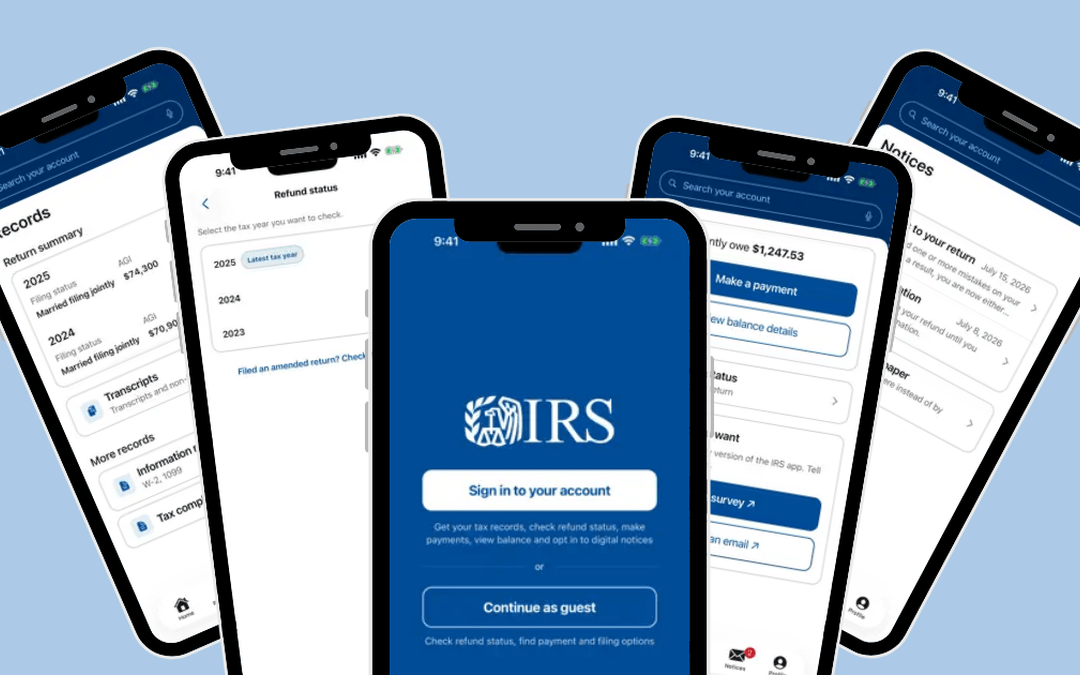
The IRS has a new mobile app. Here’s what taxpayers can do with it.
The IRS has launched a new mobile app that replaces IRS2Go, giving taxpayers quick access to refund status, payment history, tax records, IRS notices, and Identity Protection PINs. This article walks through what the app can do and how to use it safely. If something in your IRS account raises questions, a tax professional can help you make sense of it.

IRS introduces automatic penalty relief for taxpayers with a strong compliance history
The IRS is replacing its First Time Abate program with a new Automatic Exemption from Penalty (AEP), which will automatically prevent certain penalties for eligible taxpayers with a strong compliance history. Starting with 2025 tax year returns and 2026 quarterly returns, qualifying individuals and businesses may avoid failure-to-file, failure-to-pay, and failure-to-deposit penalties without needing to call the IRS or submit a separate request. Understanding the eligibility requirements and transition timeline is key to making the most of this change.

Fraud prevention strategies for nonprofit organizations
Nonprofits are disproportionately vulnerable to occupational fraud due to small administrative teams, part-time board oversight, and heavy reliance on cash-based transactions. Asset misappropriation schemes such as skimming, billing fraud, and expense reimbursement abuse are among the most common threats, and the typical scheme goes undetected for over a year. By implementing practical internal controls, strengthening board oversight, and engaging a CPA proactively, nonprofits can significantly reduce their exposure before a loss occurs.

IRS raises the standard mileage rates for the second half of 2026
The IRS raised the standard mileage rates for the second half of 2026, effective July 1, with the business rate increasing from 72.5 cents to 76 cents per mile. Taxpayers who use their vehicle for business, medical, or qualifying moving purposes will need to track mileage separately for each half of the year. Learn what the new rates mean for your deductions, reimbursement policies, and recordkeeping.

Why homeowners need to track improvements before a sale or inheritance
As home values rise, the federal home sale exclusion may no longer be enough to eliminate capital gains tax when a property is sold or inherited. The difference between a large tax bill and a smaller one can come down to how well a homeowner documented capital improvements over the years. Keeping a permanent record of qualifying expenses is one of the simplest steps homeowners can take to protect themselves.